




Sauces & gravies
DX-12 stabilizerWhey fermentate
Savory & prepared foods · Factory-direct export supply
Two working systems, not a catalog of maybes: a hydrocolloid stabilizer for texture and suspension, and a cultured whey ingredient for clean-label microbial control in chilled prepared foods. Both come with samples and a trial plan built around your line.
Start with the failure, not the ingredient
Find the symptom, check the variables that usually cause it, then trial the matching system. Texture problems and spoilage problems need different fixes, so we keep them apart.
| What you see | Check this first | System to trial |
|---|---|---|
| Sauce or gravy thins out after heating or holding | pH, solids, heat profile, shear during pumping and filling | ApexStab™ DX-12 stabilizer |
| Particles or herbs settle in dressings and soups | Particle size and density, viscosity at rest, oil phase | ApexStab™ DX-12 stabilizer |
| Texture drifts after reheating, microwaving or a delivery hold | Reheat method, hold time and temperature, starch type, fill viscosity | ApexStab™ DX-12 stabilizer, tested through your real reheat cycle |
| Salt, sugar or fat came out and the sauce lost body | What was removed, target viscosity, mouthfeel benchmark | ApexStab™ DX-12 stabilizer to rebuild body. Taste is a separate problem (see note below) |
| Water separates in chilled storage | Starch system, storage temperature, freeze-thaw history | ApexStab™ DX-12 stabilizer, screened against your current system |
| Chilled ready meal or cooked protein spoils early | Product pH, water activity, cooling rate, post-cook hygiene, pack | Whey fermentate powder |
| Taking sorbate or benzoate off the label | Current dose, pH, flavor target, milk-allergen policy | Whey fermentate powder, run side by side with your current preservative |
Straight answer: we do not make flavors, umami systems or salt replacers. If your problem is taste, say so in your brief and we will tell you whether our systems help, rather than sell you a stabilizer you do not need.
Tags show what is worth trialing in each product type. Suitability still depends on your formula, process and destination market.
DX-12 stabilizerWhey fermentate
DX-12 stabilizer
DX-12 stabilizer
Whey fermentateDX-12 stabilizer
Whey fermentate
Yield, retention and freeze-thaw for fillets and prepared meats live on our Meat & Seafood page.
Two systems
Texture & stability
A hydrocolloid stabilizer blend for viscosity, suspension and processing stability in culinary systems. The right level depends on pH, solids, protein and heat, so it is set in your formula, not copied from a sheet.
Natural preservation
A cultured ingredient fermented from glucose, whey powder and yeast extract. Its organic acids, bacteriocins and other metabolites add a microbial hurdle. It works alongside pH, cooling, hygiene and packaging, not instead of them.
Our own data
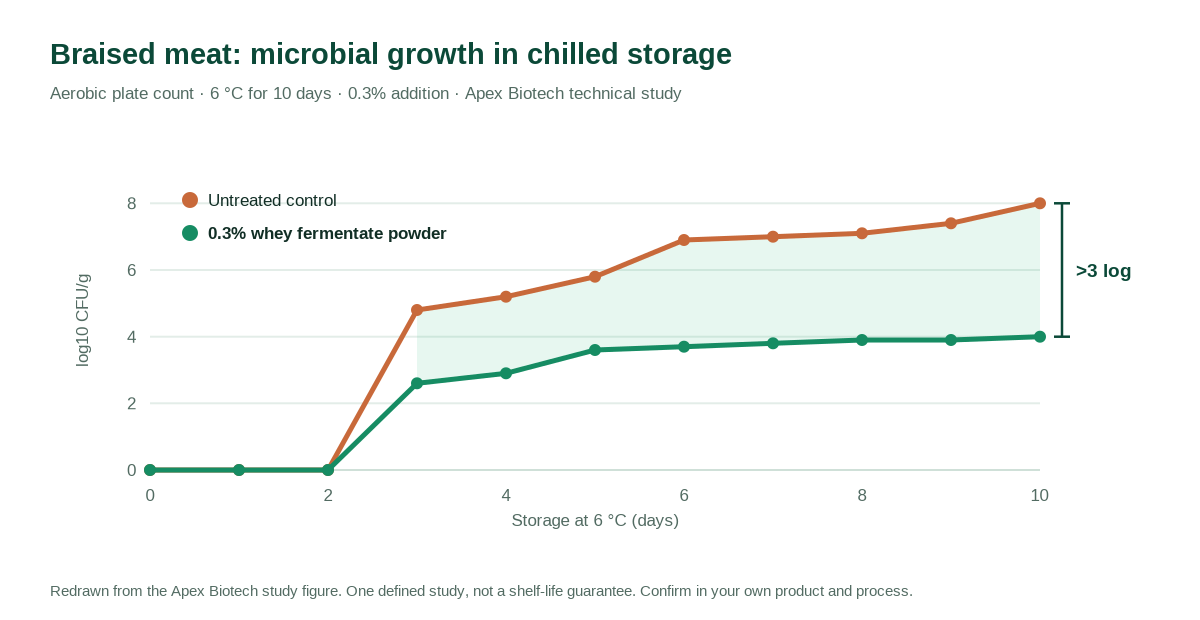
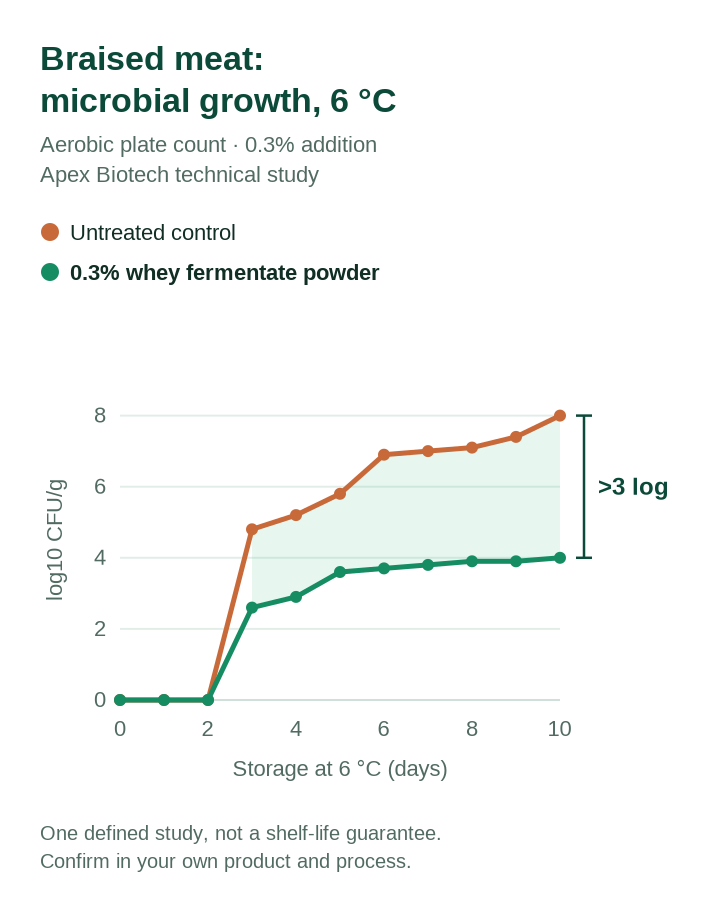
Treated braised meat stayed more than 3 log units lower in aerobic plate count than untreated samples, and the usable window ran about 7 days longer under the same conditions.
At day 10 a five-person panel (two chefs, two R&D staff, one QC) found no obvious difference from freshly made braised meat in color, aroma or eating quality.
One defined study in one product. Sauces, soups and ready meals need their own trial with an untreated control, your benchmark and agreed limits.
Acceptance limits first, then the bench work. That way the result decides, not opinion.
Formula, process, pack, storage temperature and the failure you see now.
Untreated control, your current system and a dose range for each candidate.
Viscosity, separation, sensory and microbial counts over the real storage time.
Repeat batches on your line before the specification changes.
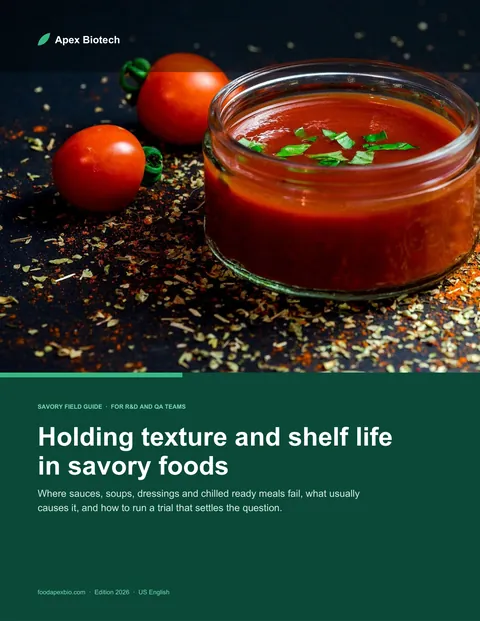
Free field guide · PDF · 12 pages
Where sauces, soups, dressings and chilled ready meals fail, what usually causes it, and how to run a trial that settles the question.
Also available: the whey fermentate technical study. For your grade and batch, request the specification, COA, SDS or certification documents.
Our documented study is in braised meat at 0.3%, stored at 6 °C. Sauces and ready meals differ in pH, water activity and processing, so they need a matrix-specific trial before any shelf-life claim. The ingredient is milk-derived, so check your allergen policy first.
In the braised-meat study, a five-person panel found no obvious difference in color, aroma or eating quality at day 10. Confirm this in your own product at your trial levels.
The level is application-specific. We set it from your pH, solids, protein and heat profile, using the current specification and COA, then confirm it on repeat batches.
The listed MOQ for ApexStab™ DX-12 is 1,000 kg, and samples are available for plant trials. Whey fermentate powder pack size, MOQ and lead time are quoted per order and destination.
The product type and formula, the process from cooking to packing, the current stabilizer or preservative and its dose, storage temperature, target shelf life and the destination market.