



Dough structure pathway
Bakery Lipase
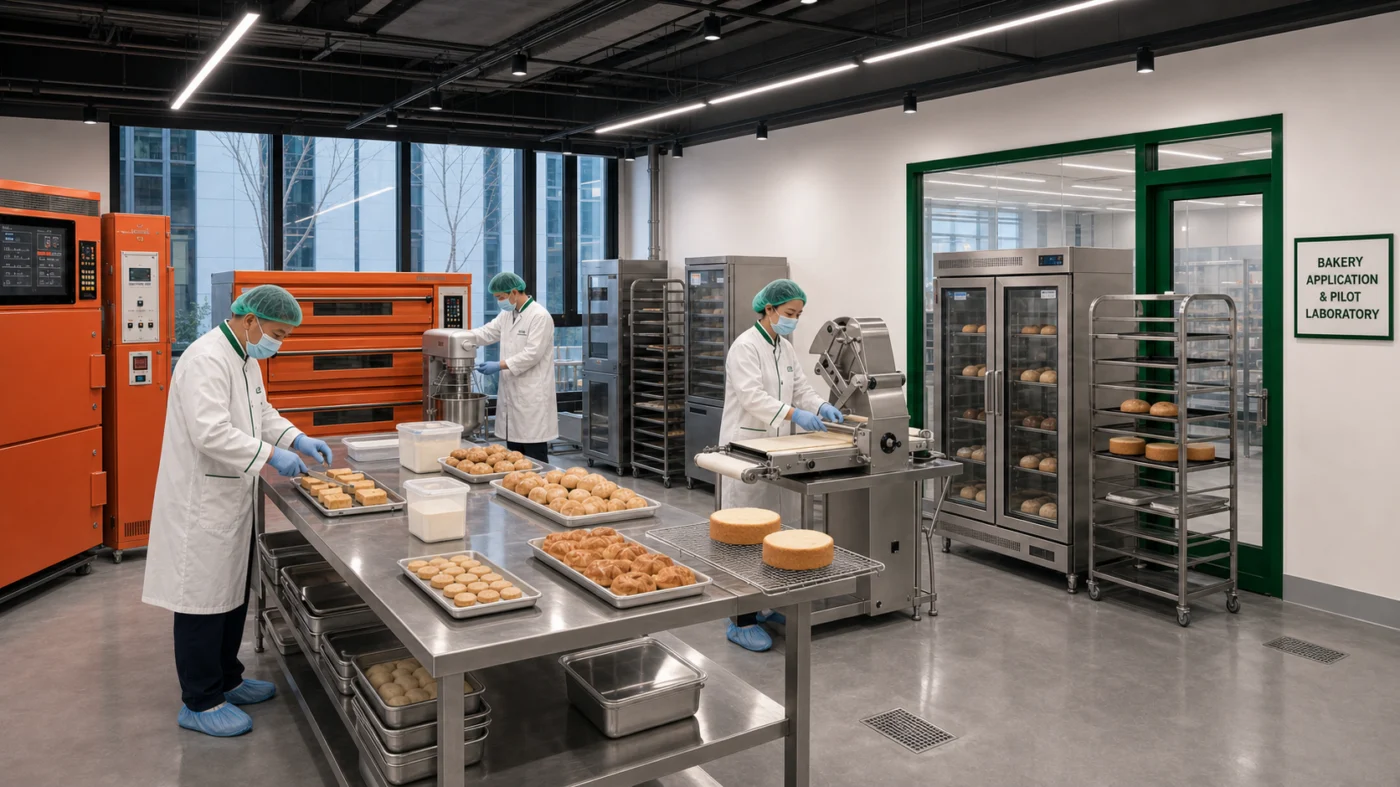
Modify selected flour lipids to evaluate proof tolerance, gas retention, volume, and crumb structure.
Application problems
Proof instability
Dough loses tolerance when fermentation time, flour quality, or mechanical stress changes.
Coarse or uneven crumb
Gas-cell behavior, gluten strength, emulsification, and lipid composition can interact.
Emulsifier-reduction projects
Replacement must be benchmarked in the full formula. Lipase is not a numerical substitute for DATEM or SSL.
Steamed-product appearance
Brightness, surface condition, resilience, internal cells, and mouthfeel require separate acceptance limits.
How lipid modification affects dough
Lipases hydrolyze selected triglycerides, phospholipids, or glycolipids according to the enzyme’s substrate preference. Reaction products can change gas-cell interfaces, gluten-lipid interactions, dough tolerance, and crumb setting.
The outcome depends on the enzyme class and grade, flour lipid composition, added shortening or oil, emulsifiers, mixing, fermentation, and use level. Confirm the offered preparation rather than assuming that all lipases behave alike.
Supplied reference sheet working range. Reference optimum 6.0-8.0.
Supplied reference sheet working range. Reference optimum 35-45 C.
Activity depends on the assay substrate and method. Do not convert units directly.
Suitable products
Bread and buns
Evaluate proof stability, oven spring, specific volume, crumb cells, softness, and sliceability.
Steamed products
Evaluate brightness, surface finish, internal structure, resilience, and mouthfeel.
Selected pastry
Confirm that lipid modification supports lamination, lift, and bite without disrupting fat functionality.
How to run the trial
Set the gradient from the actual lipase grade and COA.
- Choose one or two primary outcomes such as proof tolerance, volume, crumb softness, steamed-product brightness, or emulsifier reduction.
- Record flour source, protein quality, damaged starch, lipid context where available, emulsifiers, shortening or oil, and water absorption.
- Use an untreated control and the current improver benchmark. Hold mixing, fermentation, proofing, baking or steaming, and cooling constant.
- Build a low-to-high activity gradient from the offered grade. Do not borrow a mass dosage from another lipase product.
- Measure dough rheology, gas retention, proof stability, volume, color, crumb, firmness, resilience, flavor, and storage quality over repeat batches.
Risk boundaries
Technical
Watch for slack or sticky dough, lost handling tolerance, flavor shifts, excessive lipid hydrolysis, and an unstable crumb response.
Safety and market review
Powdered enzyme preparations should not form inhalable dust. Verify food-enzyme authorization, processing-aid treatment, labeling, and intended use for each destination market.
Frequently asked questions
What does bakery lipase do in dough?
Bakery lipases hydrolyze selected flour lipids and can change gas-cell stabilization, gluten-lipid interactions, dough tolerance, product volume, and crumb structure.
How much lipase should be added to bread?
There is no universal mass dosage. Use the offered grade, its activity method and COA, flour characteristics, formula, and a controlled production trial.
Can lipase replace DATEM or SSL?
Do not assume a one-for-one replacement. Compare the lipase system with the current emulsifier benchmark under the same production conditions and quality limits.
What happens when bakery lipase is overdosed?
A poorly matched or excessive treatment can create slack or sticky dough, loss of handling tolerance, flavor shifts, or an unstable crumb response.
Is powdered bakery lipase safe to handle?
Food suitability is grade-specific. Avoid creating inhalable dust, follow the safety data sheet, and verify the regulatory status and intended use for the destination market.